


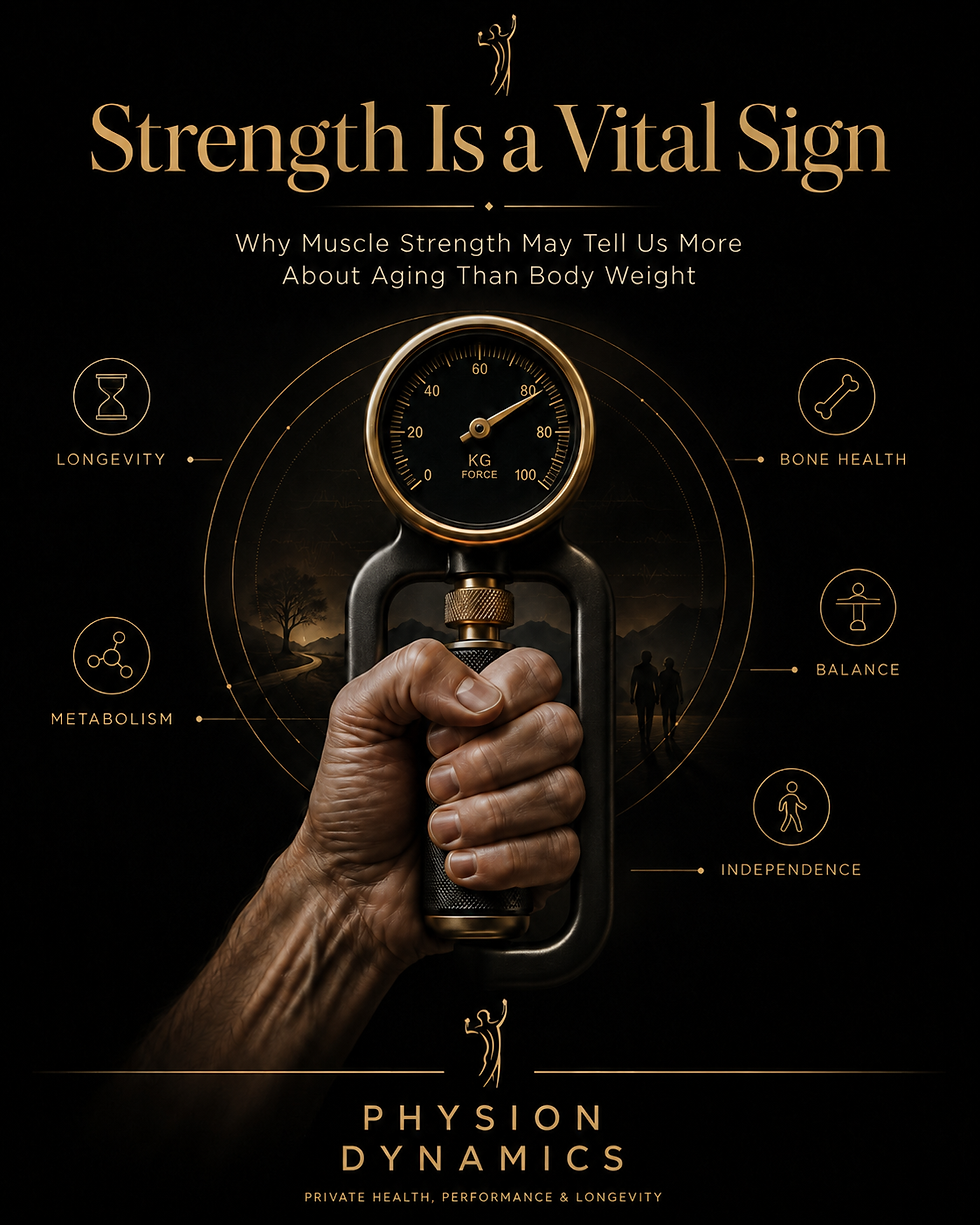
Strength Is a Vital Sign: Why Muscle Strength May Tell Us More About Aging Than Body Weight
Quick Answers
Is muscle strength really linked to longevity? Yes. Research consistently shows that lower grip strength and lower physical capability are associated with higher risk of all-cause mortality, cardiovascular mortality, frailty, and functional decline. Grip strength is not a magic crystal ball, but it is one of the simplest measurable indicators of how well the body is aging.
Why does strength matter more than body weight alone? Body weight tells us how much mass someone carries. It does not tell us how much of that weight is functional muscle, how well they move, how resilient their bones are, or whether they can climb stairs, carry groceries, train safely, recover properly, or maintain independence later in life.
Is grip strength enough to measure health? No. Grip strength is useful because it is simple, inexpensive, and strongly associated with broader health outcomes, but it should be interpreted alongside other markers such as walking speed, balance, chair-rise ability, muscle mass, bloodwork, nutrition, sleep, training history, pain, and medical background.
Can strength training help older adults? Yes. Properly designed resistance training is strongly supported for older adults because it can improve muscle strength, muscle mass, physical function, mobility, independence, chronic disease management, quality of life, and healthy life expectancy.
What should busy professionals take from this? Do not measure health only by the scale. Measure what your body can do. Strength is physiological infrastructure. It supports metabolism, posture, joint integrity, bone health, performance, confidence, and long-term independence.
Introduction: The Number Most People Ignore
Most people know their weight.
Some know their blood pressure. A smaller group may know their cholesterol, glucose, resting heart rate, or latest bloodwork markers. Many professionals can quote their revenue targets, meeting schedules, mortgage rates, investment returns, and quarterly performance numbers with impressive accuracy.
But very few people can answer one of the most important questions in long-term health:
How strong are you?
Not how much do you weigh. Not how many steps did your watch celebrate today. Not whether your suit still fits after a weekend negotiation with restaurant bread baskets. The deeper question is simpler and more revealing.
Can your body still produce force? Can you climb stairs without feeling like your lungs are filing a complaint? Can you carry heavy bags without your back threatening legal action? Can you get off the floor without using your hands? Can you grip, pull, squat, brace, balance, and recover?
These are not vanity questions. They are health questions.
For decades, health conversations have revolved around weight loss. Weight is easy to measure, easy to obsess over, and easy to weaponize against ourselves. It gives people a number to chase, celebrate, fear, or resent. But body weight alone is a crude metric. It says very little about muscle quality, joint function, metabolic health, physical capacity, balance, bone density, or independence.
A 180-pound person with strong legs, good grip strength, stable balance, and high muscle quality is living in a very different body than a 180-pound person with low muscle mass, poor strength, chronic pain, and limited mobility.
The scale sees two identical numbers.
Biology does not.
At Physion Dynamics, we view strength as one of the most important markers of human performance and aging. For executives, entrepreneurs, professionals, athletes, and aging adults, muscle strength is not just about aesthetics. It is one of the body’s most practical forms of insurance.
Strength is not merely something you build for the mirror.
Strength is a vital sign.
Muscle Strength Is More Than Gym Performance
When people hear the word “strength,” they often picture bodybuilding, powerlifting, heavy barbells, or athletes moving massive loads in a gym. That is one version of strength, but it is not the full story.
Strength is the body’s ability to produce force against resistance. It reflects the communication between the brain, nervous system, muscles, tendons, joints, and connective tissue. When someone is strong, it means their body can organize itself under demand. It means the system can coordinate, brace, stabilize, move, resist, and recover.
That matters far beyond the gym.
Strength influences how easily someone moves through daily life. It affects how well they protect their joints, how confidently they climb stairs, how safely they carry objects, how stable their posture is, and how much independence they maintain as they age. It also influences metabolic health, because skeletal muscle plays a major role in glucose storage and energy regulation.
This is why strength deserves a place beside more traditional health markers.
Blood pressure tells us something about cardiovascular strain. Blood glucose tells us something about metabolic regulation. Resting heart rate can offer clues about conditioning and recovery. Strength tells us something about physical capacity.
And physical capacity matters because life is physical.
A person may run a company, lead a team, manage assets, build a brand, or sit in executive meetings all day, but eventually life still asks the body to perform basic duties. Stand. Walk. Lift. Carry. Climb. Balance. Recover.
Aging rarely announces itself with drama. It usually enters quietly.
The stairs feel slightly steeper. The suitcase feels heavier. The hips feel tighter. Recovery after workouts takes longer. The body starts charging interest on years of underuse.
Strength training is how we push back.
What Research Says About Strength and Longevity
One of the most studied markers of strength is handgrip strength.
Grip strength is not important because hands are magical. It is important because grip strength often reflects broader neuromuscular function, total body strength, and physical capability. It is simple to measure, inexpensive, and surprisingly informative.
Large-scale research has found that lower grip strength is associated with increased risk of all-cause mortality, cardiovascular death, and cardiovascular disease. In the PURE study, which included more than 139,000 participants across multiple countries, grip strength was described as a simple and inexpensive measure that helped identify risk for all-cause death, cardiovascular death, and cardiovascular disease.
Another systematic review and meta-analysis published in The BMJ examined objective physical capability measures such as grip strength, walking speed, chair-rise performance, and standing balance. The researchers found consistent evidence that lower physical capability was associated with higher all-cause mortality in community-dwelling populations.
This does not mean grip strength itself causes longevity. That distinction matters.
Grip strength should be viewed as a marker, not a crystal ball. It gives us a window into the broader condition of the body. A stronger grip may reflect better muscle function, healthier movement habits, stronger nervous system output, better physical activity patterns, and greater physiological reserve.
In other words, grip strength is not the whole story.
It is the smoke signal.
When the signal is weak, it may suggest that the system underneath deserves closer attention.
For executives and busy professionals, this is especially important. Strength should not be treated as optional recreation. It should be treated as part of a complete health profile. If the body is losing strength every decade, the long-term health strategy has a hole in the hull.
Sarcopenia: The Quiet Loss of Muscle and Function
Aging-related muscle loss is often described through the term sarcopenia.
Sarcopenia refers to the progressive loss of skeletal muscle mass and function. In modern clinical discussions, muscle strength has become central to how we understand sarcopenia. This is important because someone can appear relatively “normal” in clothing while still losing meaningful strength and function underneath the surface. This is where body weight becomes deeply misleading.
A person may maintain the same weight for years while gradually losing muscle and gaining fat. The scale barely moves, so nothing seems urgent. But under the surface, body composition may be changing dramatically. Muscle tissue declines. Fat mass increases. Physical function begins to erode.
The result is not always obvious at first. It may begin as reduced energy, slower movement, poorer balance, lower exercise tolerance, weaker legs, or a longer recovery period after activity. Eventually, it can contribute to lower metabolic rate, reduced insulin sensitivity, increased fall risk, poorer bone loading, and loss of independence.
Sarcopenia is not simply “getting older.”
It is often accelerated by inactivity, inadequate protein intake, chronic stress, poor sleep, illness, certain medications, inflammation, and long periods of sedentary behavior.
For high-performing professionals, this matters because the modern executive lifestyle is almost perfectly designed to erode muscle over time.
Long sitting hours. High stress. Poor sleep. Irregular meals. Travel. Alcohol at dinners. Minimal progressive resistance training. Weekend bursts of activity trying to compensate for five days of biological neglect. The body does not suddenly fail. It adapts.
If most of the week is spent sitting, rushing, under-sleeping, and under-recovering, the body becomes very good at surviving that lifestyle. But survival is not the same as performance.
Muscle loss is not only an aging issue. It is a lifestyle issue. The earlier strength is trained and preserved, the more physical reserve a person carries into later decades.
Strength, Metabolism, and Insulin Sensitivity
Skeletal muscle is one of the body’s most important sites for glucose disposal.
When we eat carbohydrates, a significant portion of glucose can be stored in muscle as glycogen. Active muscle tissue gives the body a larger and more responsive storage system for energy. This is one reason resistance training plays such an important role in metabolic health.
Muscle is not passive tissue. It is metabolically active. It helps regulate glucose handling, energy expenditure, and overall metabolic flexibility.
When muscle mass and muscle function decline, the body can become less efficient at handling energy. This does not mean fat gain is inevitable, but it does mean the system becomes less forgiving.
For a busy executive or professional, this can show up in frustrating ways. They may feel like they gain fat more easily despite “not eating that much.” They may struggle more after restaurant meals, alcohol, travel, or poor sleep. They may feel larger energy crashes after carbohydrate-heavy meals. Their training output may decline. Their waistline may become more stubborn. They may depend more heavily on caffeine just to feel functional.
The answer is not panic. The answer is building a stronger system.
Resistance training improves the body’s ability to use and store nutrients. It creates a biological demand for protein, carbohydrates, minerals, hydration, and recovery. It gives nutrition somewhere productive to go.
Without muscle, nutrition plans become more fragile. With muscle, the body becomes more metabolically expensive, more resilient, and more capable.
This is why strength training is not just something we add after the “real” fat-loss work is done. It is part of the foundation. For fat loss, blood sugar control, energy, and long-term metabolic health, muscle is central architecture.
Strength, Bone Density, and Fall Prevention
Muscle and bone are deeply connected. Bones respond to mechanical loading. When muscles pull on bones during resistance training, that stress helps signal the body to maintain or improve bone strength. This becomes especially important with age, when bone mineral density may decline and fracture risk increases.
This is also why a complete longevity program cannot rely only on walking. Walking is excellent for cardiovascular health, circulation, mood, and baseline activity, but it does not create the same mechanical loading as progressive resistance training. For older adults, this distinction matters.
Falls are not always random accidents. Often, they are the final visible event after years of declining strength, balance, reaction time, coordination, bone density, and confidence.
A fall at 30 may be embarrassing, a fall at 75 can be life-changing.
Resistance training helps protect the body by improving force production, joint control, posture, and the ability to recover from unexpected movement. Stronger legs, hips, back, and core muscles are not merely aesthetic assets. They are anti-fragility tools.
The goal is not to chase youth. The goal is to preserve capacity. Strength training gives aging adults a better chance at maintaining independence, protecting bone health, reducing fall risk, and living with confidence.
Why Executives Lose Strength Faster Than They Realize
Executives and professionals are often not inactive because they are lazy. They are inactive because their lives are expensive in time, attention, stress, and decision-making.
The typical high-performing lifestyle creates a strange paradox: the mind is overloaded while the body is underloaded. Long sitting hours reduce the demand on the lower body, trunk, and postural muscles. Over time, the body adapts by becoming less strong in the ranges and positions it no longer uses. The glutes become less active. The hips stiffen. The upper back weakens. The neck and shoulders absorb more strain.
Travel adds another layer. Flights, hotels, restaurant meals, dehydration, disrupted sleep, and missed workouts all chip away at consistency. Travel is not just a schedule disruption. It is a physiology disruption.
Chronic stress also plays a role. Stress does not automatically destroy progress, but unmanaged stress can reduce sleep quality, impair recovery, increase cravings, and make training consistency harder. A tired, overstimulated nervous system does not adapt as efficiently.
Nutrition becomes another silent problem. Busy professionals often under-eat protein during the day, overeat later at night, rely on convenience foods, or consume most of their calories in social and business settings. They may not be eating “terribly,” but the structure is inconsistent enough to weaken results.
Then comes the biggest issue: many people exercise without actually building strength. Random workouts, light circuits, and occasional sweat sessions can be useful, but strength requires progression. The body needs a reason to adapt. If training never becomes gradually more challenging, strength does not climb. It circles the parking lot. A busy lifestyle does not eliminate the need for strength training. It increases the need for intelligent programming.
The Physion Dynamics Strength Benchmark Framework
Strength should be assessed intelligently, not emotionally. The goal is not to compare a 55-year-old executive with a 25-year-old competitive athlete. The goal is to create a personal performance baseline and improve it safely over time.
Grip strength is one useful starting point. A hand dynamometer can measure grip strength quickly, and the result can be interpreted relative to age, sex, body size, injury history, occupation, and training background. It is not a complete diagnosis, but it can provide a
useful snapshot of general strength status and neuromuscular function.
Another practical test is the chair-rise test. The ability to stand from a chair repeatedly without using the hands tells us a great deal about lower body strength, coordination, balance, and functional independence. For older adults, this type of ability is not cosmetic. It is directly tied to daily life.
Loaded carries are also highly valuable. Carrying weight safely while maintaining posture, control, and breathing reveals grip strength, core stability, gait quality, and total-body coordination. In many ways, loaded carries represent real-world strength better than many isolated gym movements.
Basic squat or sit-to-stand patterns can reveal whether someone can control their hips, knees, ankles, and spine through a foundational movement. Rowing and pulling strength can reveal upper back strength, postural control, shoulder function, and grip. Balance and single-leg control can show how well the body manages instability, weight shift, and coordination. The key is context.
Strength should not only be measured by absolute load. It should also be considered relative to body weight, pain status, training age, medical background, mobility, and daily demands.
A 250-pound person and a 130-pound person do not need the same absolute strength numbers. But both need enough strength to move well, protect joints, and live independently.
Strength assessment should be personal, progressive, and functional. The goal is not ego lifting. The goal is measurable capacity.
How to Train Strength for Longevity
A proper strength program does not need to be extreme. It needs to be consistent, progressive, and matched to the individual. For longevity, resistance training should include the major movement patterns of human life: squatting, hinging, pushing, pulling, carrying, bracing, rotating, balancing, and moving through controlled ranges of motion.
Lower body strength is essential because the legs support walking, stairs, balance, and independence. Exercises such as squats, sit-to-stands, leg presses, split squats, step-ups, Romanian deadlifts, hamstring curls, and calf raises can all be useful when selected appropriately.
Upper body pulling is equally important, especially in a desk-heavy world. Rows, pulldowns, band rows, and dumbbell rows help strengthen the upper back, support posture, improve shoulder mechanics, and reinforce grip.
Upper body pushing also has a place, but it should be programmed intelligently. Push-ups, incline push-ups, chest presses, dumbbell presses, and landmine presses can help maintain upper body function, provided the shoulders are respected and technique is controlled.
Carries deserve special attention. Farmer’s carries, suitcase carries, front rack carries, and sled pushes can train grip, posture, trunk stability, gait, and breathing all at once. They are simple, brutally honest, and deeply functional. No machine negotiations. No theatrical nonsense. Just the body moving load through space.
Core training should focus on stability, not endless crunches. The core’s job is to transfer force, resist unwanted movement, and protect the spine. Dead bugs, Pallof presses, planks, side planks, bird dogs, and loaded carries are excellent tools when used properly.
For appropriate clients, power and speed should also be considered. Aging affects not only strength but also power. The ability to react quickly, move decisively, and recover balance matters. Medicine ball throws, controlled step-ups, light sled work, and fast but controlled concentric movements may be useful depending on the individual.
Mobility and balance complete the picture. Strength is most useful when the body can access safe ranges of motion and control them. Hip mobility, thoracic mobility, ankle mobility, single-leg balance, controlled lunging, and gait drills can all support a stronger, more capable body.
A longevity program should not merely make someone tired. It should make them harder to break.
Nutrition: The Raw Material for Strength
Training provides the signal. Nutrition provides the building materials.
For muscle preservation and growth, protein intake is especially important. Older adults and highly active individuals may need careful attention to protein distribution, total calories, micronutrients, hydration, and recovery habits.
The challenge for many busy professionals is not that they lack information. Most people know they should eat more protein, hydrate better, sleep more, and stop treating airport food courts as emergency survival zones. The challenge is execution.
The best nutrition plan is the one that survives meetings, travel, client dinners, late nights, family responsibilities, and real life. Protein should be distributed across the day rather than treated as an afterthought at dinner. Calories should support the goal, whether that goal is fat loss, muscle gain, strength maintenance, or performance. Carbohydrates should be placed strategically when training demands are higher. Healthy fats should support satiety, hormones, and cellular health. Hydration and electrolytes matter more than most people realize, especially for those who train, travel, sweat, or drink large amounts of caffeine.
For aging adults, nutrients such as calcium, vitamin D, iron, B12, magnesium, and omega-3 fatty acids may also deserve attention depending on dietary intake, bloodwork, medical history, and clinical guidance.
Strength training without nutrition is like trying to build a luxury property with no materials on site. The blueprint may be beautiful, but the structure still needs resources.
That is where coaching becomes valuable. Not because people need another generic meal plan, but because they need a system that fits the demands of their life.
Common Myths About Strength and Aging
One of the most damaging myths is the idea that someone is “too old” to build strength.
Older adults can improve strength, function, mobility, and muscle mass with properly designed resistance training. The program must be matched to health status, training history, pain, mobility, and medical considerations, but age alone is not a disqualifier. Another common myth is that walking is enough.
Walking is excellent. It supports cardiovascular health, circulation, mood, and baseline activity. But walking does not fully replace resistance training. It does not challenge muscle strength, bone loading, power, and functional capacity in the same way. Walking and strength training are teammates, not substitutes. There is also the belief that lifting weights is dangerous.
Poorly coached lifting can be risky. So can poor movement, inactivity, weakness, and falling. A properly designed resistance training program with appropriate technique and progression can be adapted for many ability levels and can be an important part of healthy aging. Then there is the myth that the scale tells the whole story.
The scale tells you mass. It does not tell you strength, muscle quality, balance, bone density, glucose handling, posture, mobility, or resilience. Body weight is one data point. It should not be promoted to emperor. Finally, many people still believe strength training is only for athletes.
Athletes train for sport. Executives train for life performance. Older adults train for independence. Different goals, same biological principle. Strength training is for anyone who wants to move better, age better, reduce frailty risk, preserve independence, and maintain physical confidence.
The Executive Strength Protocol
For busy professionals, the ideal plan is not the most complex plan. It is the most executable plan. A strong starting point for many people is two strength sessions per week. This can be enough for beginners, older adults, busy executives, people returning from injury, or individuals in a maintenance phase. These sessions should usually be full-body, focused on major movement patterns, controlled progression, and technique quality.
For those seeking more significant improvements in fat loss, muscle gain, longevity, and body composition, three strength sessions per week is often a stronger target. This allows enough frequency to train the lower body, upper body, core, carries, and mobility without overwhelming recovery.
More advanced individuals may train four times per week, especially if they have physique goals, athletic goals, or higher performance targets. But more training only works if recovery, nutrition, sleep, and stress management can support it.
No matter the frequency, the non-negotiables remain the same. Train the lower body. Pull more than most desk workers think they need. Include loaded carries when appropriate. Practice balance and single-leg control. Progress gradually. Eat enough protein. Sleep with intent. Adjust training around travel and stress rather than pretending life does not exist.
Busy professionals do not need random workouts. They need a strength operating system.
When to Seek Medical or Clinical Input
Strength training is powerful, but it should be applied intelligently. A medical or clinical referral may be appropriate when someone experiences unexplained rapid strength loss, severe fatigue, dizziness, fainting, chest pain, neurological symptoms, sudden balance changes, severe joint pain, recent fracture, significant osteoporosis risk, uncontrolled blood pressure, unexplained weight loss, or new numbness, tingling, or weakness. Strength is a vital sign, but it is not a diagnosis by itself.
If strength is declining rapidly, the question is not only, “What exercises should I do?”
The question is, “Why is this happening?” That is where physicians, physiotherapists, dieticians, qualified exercise specialists, and other health professionals may need to work together.
Training should challenge the body, not gamble with it. Intelligent progression wins.
Conclusion: Strength Is Physiological Wealth
The modern world has made it easy to look successful while becoming physically under-built. A person can have a full calendar, a growing business, a beautiful watch, a demanding career, and a body quietly losing capacity in the background. That is the danger.
Strength loss does not always feel urgent until it becomes obvious. The better approach is to treat strength as a leading indicator. A measurable signal. A form of physiological wealth.
Strength supports more than muscle. It supports metabolism, bone health, balance, independence, confidence, energy, longevity, and the ability to keep living life on your terms.
At Physion Dynamics, we believe strength should be assessed, trained, and protected with the same seriousness as any other performance metric. Your body is not simply a vehicle for your ambition. It is the infrastructure that allows ambition to keep moving. And infrastructure must be maintained.
Physion Dynamics Takeaway
If you are a busy executive, entrepreneur, professional, athlete, or aging adult, do not wait until weakness becomes obvious. Start tracking strength now. Not for ego. Not for vanity. Not to chase someone else’s numbers.
Train strength because it is one of the clearest signs that your body is still capable, adaptable, and resilient. Strength is not just fitness. Strength is freedom.
Call to Action
If you want to understand where your body currently stands and build a personalized plan for strength, fat loss, mobility, recovery, and long-term performance, book a Physion Dynamics Concierge Private Health & Performance Review.
This private review is designed to assess your current lifestyle, training history, nutrition, stress, sleep, body composition goals, and performance needs so we can create a strategy that fits your life instead of fighting against it.
Physion Dynamics Private Health, Performance & Longevity Coaching for executives, professionals, athletes, and aging adults who expect more from their body.
FAQ
1. Is strength more important than body weight?
Strength and body weight measure different things. Body weight tells you how much mass you carry. Strength tells you how well your body can produce force, move, stabilize, and function. For long-term health, strength often provides information that body weight alone cannot.
2. Why is grip strength associated with longevity?
Grip strength is easy to measure and often reflects broader neuromuscular health and total physical capability. Studies have found that lower grip strength is associated with higher risk of all-cause mortality and cardiovascular mortality, although it should be interpreted as a marker rather than a direct cause.
3. Can older adults still build muscle?
Yes. Older adults can improve strength, function, mobility, and muscle mass with properly designed resistance training. The program should be individualized based on health status, experience, mobility, pain, and medical considerations.
4. How many days per week should I strength train?
Many people benefit from two to three resistance training sessions per week. Beginners, older adults, and busy executives may start with two well-designed full-body sessions. More advanced individuals may use three to four sessions depending on recovery, goals, and schedule.
5. Is walking enough for healthy aging?
Walking is excellent, but it does not replace resistance training. Walking supports cardiovascular health and daily activity, while strength training better targets muscle strength, muscle mass, bone loading, balance, and functional capacity.
6. Does strength training help bone density?
Resistance training places mechanical stress on bones, which may help preserve or improve bone strength when programmed appropriately. Osteoporosis guidance supports resistance, balance, and functional training as part of fracture and fall prevention strategies.
7. Should I train heavy as I age?
Heavy is relative. The goal is not reckless loading. The goal is progressive, safe resistance that challenges the body at an appropriate level. For some people, that may be bodyweight training. For others, it may include heavier resistance under expert supervision.
8. What is sarcopenia?
Sarcopenia is the progressive loss of skeletal muscle mass and function, commonly associated with aging but also influenced by inactivity, nutrition, illness, and lifestyle. Modern definitions place strong emphasis on muscle strength and physical function.
9. Can strength training help fat loss?
Yes. Strength training helps preserve or build lean muscle, supports metabolic health, improves glucose handling, and can increase total daily energy expenditure over time. It is especially important during fat loss because it helps protect muscle while body weight decreases.
10. When should I get professional guidance?
Professional guidance is recommended if you are new to training, have pain, osteoporosis, past injuries, balance issues, medical conditions, or significant strength loss. A qualified coach or clinician can help you train safely and progressively.
Peer-Reviewed References
Leong, D. P., et al. Prognostic value of grip strength: findings from the Prospective Urban Rural Epidemiology (PURE) study. The Lancet, 2015.
Cooper, R., et al. Objectively measured physical capability levels and mortality: systematic review and meta-analysis. BMJ, 2010.
Fragala, M. S., et al. Resistance Training for Older Adults: Position Statement From the National Strength and Conditioning Association. Journal of Strength and Conditioning Research, 2019.
Dent, E., et al. International Clinical Practice Guidelines for Sarcopenia. Journal of Nutrition, Health & Aging, 2018.
Kirk, B., et al. Sarcopenia. Nature Reviews Disease Primers, 2024.
Cheung, A. M., et al. Clinical practice guideline for management of osteoporosis and fracture prevention in Canada: 2023 update. CMAJ, 2023.
Zhao, R., et al. Progressive Resistance Training for Concomitant Increases in Muscle Strength and Bone Mineral Density in Older Adults: A Systematic Review and Meta-Analysis. Sports Medicine, 2022.
Kunutsor, S. K., et al. Handgrip strength is inversely associated with fatal cardiovascular and all-cause mortality events. Annals of Medicine, 2020.
García-Hermoso, A., et al. Associations Between Handgrip Strength and Disease-Specific Mortality Including Cancer, Cardiovascular, and Respiratory Diseases in Older Adults: A Meta-Analysis. Journal of the American Medical Directors Association, 2020.
Cruz-Jentoft, A. J., et al. Sarcopenia: Aging-Related Loss of Muscle Mass and Function. Physiological Reviews, 2019.
Written By
Dragos Mutascu
Founder & Head Coach, Physion Dynamics
Masters in Kinesiology and Health Sciences | ISSA Certified Personal Trainer and Nutrition Specialist | Physiotherapist in Training
Dragos Mutascu is the Founder and Head Coach of Physion Dynamics, a private health, performance, and longevity coaching brand built for executives, professionals, athletes, and aging adults who want a more intelligent approach to fitness. With a background in kinesiology, strength training, nutrition, corrective exercise, and performance coaching, Dragos helps clients build stronger bodies, improve body composition, protect long-term health, and train with purpose.
Through Physion Dynamics, his work focuses on combining evidence-based exercise science with highly personalized coaching systems, helping clients move beyond generic fitness plans and into structured, sustainable, results-driven health strategy.
Physion Dynamics
Private Health, Performance & Longevity Coaching


Comments