


The Executive Health Operating System: Why Busy Professionals Don’t Need Another Workout Plan
How training, nutrition, recovery, stress, travel, and lifestyle design must work together for real transformation
Quick Answers
Why do busy professionals struggle to stay consistent with health and fitness?
Busy professionals rarely struggle because they lack ambition. More often, their lifestyle is built around constant demands, shifting schedules, late meetings, travel, stress, social obligations, and sleep disruption. Their health plan fails because it was designed for a predictable life they do not actually live.
Why is a generic workout plan not enough?
A workout plan only addresses exercise. Real transformation requires the surrounding system to work as well: nutrition, recovery, sleep, stress regulation, mobility, daily movement, travel planning, accountability, and lifestyle structure.
What is an Executive Health Operating System?
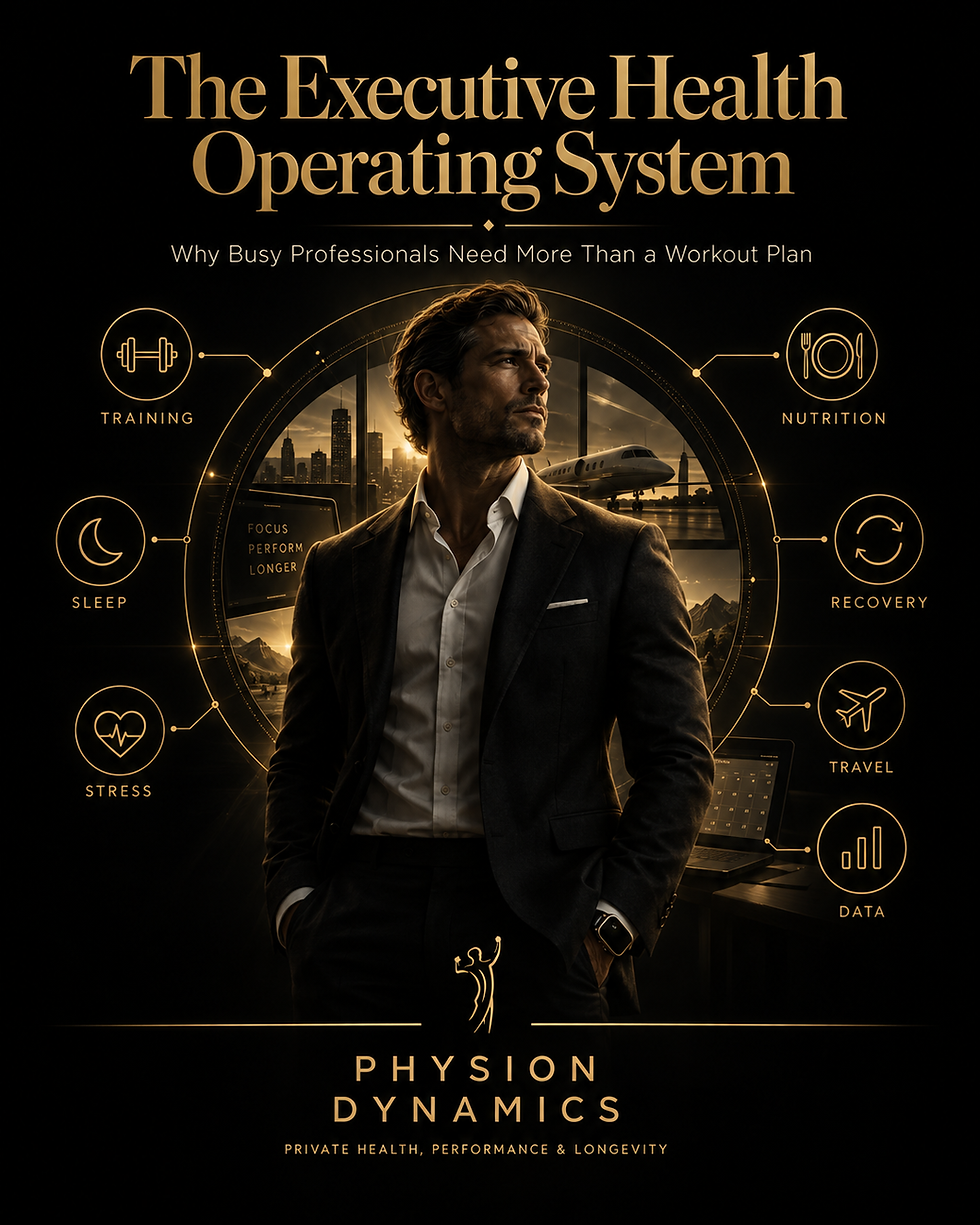
An Executive Health Operating System is an integrated strategy for managing the body inside a demanding professional life. It connects training, nutrition, recovery, sleep, stress, travel, wearable data, and behavior patterns into one adaptable coaching model.
How is a Lifestyle Transformation and Health Optimization Coach different from a personal trainer?
A personal trainer typically focuses on exercise sessions. A Lifestyle Transformation and Health Optimization Coach looks at the entire environment that determines whether the body changes: schedule, food, sleep, stress, travel, habits, accountability, and long-term performance.
What should busy professionals track besides body weight?
Body weight is only one data point. Strength, waist measurements, training performance, sleep quality, energy, digestion, resting heart rate, heart rate variability, steps, recovery, mood, and consistency patterns often tell a much more useful story.
Introduction: The Problem Is Not Discipline. The Problem Is the System.
Most busy professionals do not fail because they are lazy. They fail because their health is being asked to survive inside a schedule that was never designed to support it.
The modern professional life is a machine that rewards speed, responsiveness, availability, ambition, and constant output. The calendar fills before the day has even had a chance to breathe. Meals become reactive. Workouts become negotiable. Sleep gets treated like a luxury upgrade instead of a biological requirement. Stress becomes so familiar that it stops feeling like stress and starts feeling like “normal.”
Then the body begins to send invoices. Energy drops. Fat loss slows. Sleep becomes lighter. Cravings become louder. Back pain becomes a recurring meeting that nobody invited. Training feels inconsistent. The scale creeps upward. The mind still wants to perform, lead, build, and execute, but the body begins asking for better management.
This is where many professionals make the wrong assumption. They believe they need more motivation, more discipline, a harder workout, a stricter diet, or another attempt to “get back on track.” But for people living demanding lives, the track itself is often the problem. It disappears under airport terminals, dinner meetings, deadlines, family obligations, long workdays, poor sleep, and decision fatigue.
For high performers, the issue is rarely lack of effort. The issue is the absence of a complete health system. At Physion Dynamics, transformation is not treated as a collection of random workouts and meal suggestions. The body is treated as a performance ecosystem. Training affects sleep. Sleep affects appetite. Stress affects recovery. Nutrition affects energy. Travel affects digestion. Sitting affects mobility. Poor recovery affects strength. Every part of the system speaks to every other part. That is why busy professionals do not need another generic workout plan. They need an Executive Health Operating System.
Quick Answer: What Is an Executive Health Operating System?
An Executive Health Operating System is a complete and adaptable structure for managing physical performance inside a demanding life. It connects strength training, cardiovascular health, nutrition, sleep, recovery, stress regulation, travel planning, daily movement, biometric data, and accountability into one integrated coaching model.
1. Why Motivation Is Not a Strategy
Motivation is useful, but it is not dependable enough to build a life around. It appears when conditions are friendly. It loves a clean calendar, a quiet morning, new gym shoes, Monday optimism, and the fantasy version of life where nothing interrupts the plan. But motivation becomes far less heroic at 9:30 p.m. after three meetings, two missed meals, a delayed commute, a stressful conversation, and a client dinner that somehow involved bread, wine, dessert, and an emotional support espresso.
For a busy professional, relying only on motivation is like building a luxury home on a trampoline. It may look impressive for a moment, but the foundation is chaos. A serious health strategy cannot depend on how someone feels on their best day. It has to survive their worst week. That is where systems outperform willpower. A system already knows what happens when the meeting runs late. A system already knows what to order when the restaurant menu is unpredictable. A system adjusts training when sleep quality drops. A system creates default decisions so the brain does not have to solve the same health problems every single day.
This matters because self-monitoring, feedback, and structured behavior strategies have been shown to support health behavior change. A systematic review and meta-analysis found that digital self-monitoring of diet and physical activity helped support weight loss, improve moderate physical activity, and reduce calorie intake in adults with overweight or obesity, especially when engagement and feedback were part of the process. In plain language, people tend to do better when the plan is visible, trackable, adjustable, and supported.
A busy professional does not need to become obsessed with numbers. But they do need a structure that reduces guesswork. When life gets busy, the brain defaults to convenience, and convenience rarely cares about blood sugar, lower back pain, long-term health, or how sharp someone wants to feel walking into a boardroom.
2. A Workout Plan Is Not the Same as a Health System
A workout plan tells someone what exercises to do. A health operating system tells someone how to live in a way that allows those exercises to actually work. That distinction is everything.
A workout plan might say, “Train legs on Monday.” But what happens when Monday becomes a twelve-hour workday? A workout plan might say, “Eat enough protein.” But what happens when lunch is a catered meeting, dinner is at a restaurant, and the only thing available at 4 p.m. is coffee and regret? A workout plan might say, “Sleep eight hours.” But what happens when travel, stress, family, deadlines, and late-night work reduce that to five A generic plan collapses when life becomes complicated. A proper health operating system adapts.
It does not pretend the client lives inside a fitness magazine with perfect lighting, matching containers, and unlimited free time. It respects the reality of a demanding schedule and builds solutions around it.
This is the shift that separates Physion Dynamics from ordinary personal training. A personal trainer may guide the session. A Lifestyle Transformation and Health Optimization Coach manages the environment around the session, because the body does not only adapt to workouts. It adapts to the entire life. The workout is the signal. The lifestyle determines whether the body can respond.
Quick Answer: Why Do Most Fitness Plans Fail for Executives?
Most fitness plans fail for executives because they are designed for predictable routines. Busy professionals need flexible systems that can adapt around travel, meetings, stress, poor sleep, social obligations, and changing energy levels without losing direction.
3. Training: Building the Body’s Physical Infrastructure
Training is still essential. The point is not to replace exercise with lifestyle talk. The point is to make exercise intelligent enough to serve the life someone actually lives. Strength training builds the body’s physical infrastructure. It supports muscle, joints, posture, movement quality, metabolic health, bone loading, injury resilience, and long-term physical independence. The World Health Organization recommends regular physical activity for adults and older adults, including muscle-strengthening activity, while also emphasizing the importance of reducing sedentary time.
For busy professionals, training should not be random. Every session should have a purpose. Some phases should prioritize strength. Others should focus on mobility, cardiovascular conditioning, recovery, or movement quality after long hours of sitting or frequent travel. There are times to push, times to maintain, and times to recover. A proper program understands the difference. The body does not need punishment. It needs precise stress followed by adequate recovery.
An executive who slept four hours, skipped lunch, flew across time zones, and walked into a session mentally exhausted does not always need the same training stimulus as the same person on a rested, well-fed, low-stress day. Intelligent coaching recognizes the difference. That is the value of programming. Exercise makes someone tired. Programming makes someone better.
At Physion Dynamics, training is not viewed as isolated gym work. It is part of a larger performance system. The goal is not simply to sweat. The goal is to adapt, move better, build strength, protect the body, and create a physical foundation that supports a demanding life.
4. Nutrition: Performance Must Survive Real Life
Most nutrition plans fail at the exact moment life becomes social, unpredictable, or inconvenient. That is why “eat clean” is not a strategy. It is a vague wish wearing a gym hoodie. Busy professionals need nutrition systems that account for real life: early meetings, late dinners, travel days, airports, restaurants, social pressure, appetite swings, stress eating, alcohol exposure, and inconsistent meal timing. Nutrition is not just about knowing what protein, carbohydrates, fats, fiber, and calories are. It is about being able to execute the right decision when the day has become messy.
A high-performing nutrition strategy answers practical questions before they become problems. What should someone eat before a long meeting? What should they order at a steakhouse? What happens when lunch gets missed? What should be kept at the office? How should travel days be handled? How can someone avoid overeating late at night after under-fueling all day? This is where coaching becomes powerful. The client does not need another generic PDF that says “chicken, rice, vegetables.” They need options, adjustments, structure, and a decision-making framework that works when life refuses to behave. Tracking can help, but tracking is not meant to become a prison. It is meant to become a flashlight. It shows what is actually happening instead of relying on memory, which becomes suspiciously generous after a chaotic week and three cappuccinos.
Research on digital self-monitoring supports its usefulness for improving diet and activity behaviors when paired with feedback and consistent engagement.
The best nutrition plan for a busy professional is not the most extreme plan. It is the one that can survive meetings, travel, restaurants, stress, family life, and fatigue while still moving the body toward the desired outcome.
Quick Answer: What Is the Best Diet for Busy Professionals?
The best diet for busy professionals is not the most restrictive diet. It is the most executable one. It should support protein intake, stable energy, digestion, hydration, recovery, body composition, and real-world flexibility around restaurants, travel, late meetings, and demanding schedules.
5. Recovery: The Hidden Lever of High Performance
Executives understand output. They understand deadlines, targets, expectations, and pressure. But many do not understand recovery until the body forces the conversation.
Recovery is not laziness. Recovery is where adaptation happens. Training gives the body a signal. Recovery determines whether the body can use that signal. Sleep, nutrition, hydration, nervous system regulation, and proper programming all influence how well someone adapts. When recovery is poor, strength drops, cravings rise, mood changes, injuries become more likely, motivation decreases, and body composition becomes harder to change.
Sleep is especially important because it affects both the body and the brain. Meta-analytic research has found that sleep restriction can impair cognitive performance across several domains, including executive function, sustained attention, and memory. More recent meta-analytic work has also examined the impact of sleep loss on core executive functions such as working memory, inhibitory control, and cognitive flexibility. This matters deeply for professionals. The same brain being asked to lead teams, negotiate deals, treat clients, manage risk, solve problems, and make strategic decisions is also the brain being asked to regulate appetite, control impulses, plan workouts, and make good nutrition decisions.
When sleep declines, the entire operating system slows down. This does not mean every person needs perfect sleep every night. Real life rarely gives anyone that luxury. But it does mean sleep should be treated as a central performance variable, not an optional afterthought.
In a Physion Dynamics coaching model, recovery is not left floating in the fog. It is monitored, discussed, adjusted, and protected. Because there is no elite performance without recovery. There is only temporary overextension wearing a nice jacket.
6. Stress and Decision Fatigue: The Silent Saboteurs
Stress is not automatically bad. Acute stress can sharpen attention and help the body respond to challenge. The problem begins when stress becomes chronic, unmanaged, and layered on top of poor sleep, inconsistent nutrition, constant sitting, inadequate recovery, and endless decision-making. The brain’s executive functions include working memory, cognitive flexibility, inhibition, planning, and decision-making. A meta-analysis on acute stress and executive function found that stress can affect core executive functions, with outcomes depending on factors like timing, intensity, and context.
For a busy professional, this has very practical consequences. The person who can make disciplined decisions at 9 a.m. may become a completely different creature at 9 p.m. Morning self wants grilled salmon, mobility work, and a clean bedtime routine. Evening self wants takeout large enough to require municipal approval. That is not a character flaw. That is physiology meeting environment.
Decision fatigue matters because every unresolved health choice taxes the system. What should I eat? When should I train? Should I push or recover? What do I do if I missed lunch? How do I handle the dinner? How do I get back on track after travel? The more decisions someone has to make under pressure, the more likely they are to choose whatever is easiest, fastest, or most immediately rewarding. That is why strong coaching reduces unnecessary decisions.
A properly designed health operating system creates defaults. It prepares for high-risk moments. It builds travel rules, meal structures, flexible workouts, recovery options, and accountability. It does not simply demand more discipline. It designs the environment so discipline is needed less often. That is lifestyle architecture.
Quick Answer: Is Stress Stopping My Fat Loss?
Stress does not magically erase energy balance, but it can make fat loss harder by affecting sleep, appetite, cravings, recovery, training performance, daily movement, and consistency. The solution is not blaming everything on cortisol. The solution is building a system that helps the body perform better under stress.
7. Sedentary Time: The Health Risk Hiding in the Executive Chair
Many professionals work hard mentally while their bodies remain physically underloaded.
This creates a strange and dangerous mismatch. A person may feel exhausted at the end of the day, but that exhaustion often comes from cognitive load, emotional stress, screen exposure, and decision-making, not from healthy physical movement. The body has been tired, but not trained.
Sedentary behavior is now recognized as an important health concern. WHO guidance recommends limiting sedentary time and replacing it with physical activity whenever possible. An overview of systematic reviews found that sedentary behavior is related to several health outcomes in adults and older adults, although the certainty of evidence varies by outcome. This matters because many busy professionals assume one workout can erase an otherwise motionless day. A workout helps, but it is not the whole picture. The body benefits from movement distributed throughout the day. Short walks, standing breaks, stair use, mobility resets, postural changes, and brief movement between calls can all help interrupt the physical stagnation that builds during long workdays. None of these actions need to be dramatic. Nobody needs to abandon their career and become a forest monk with resistance bands. The goal is to create intelligent movement anchors that fit inside the day.
An executive body does not only need gym intensity. It needs movement frequency.
That is what a complete system provides.
8. Travel: Where Most Health Plans Go to Die
Travel exposes the weakness of generic fitness plans. A plan that only works inside one gym, one kitchen, one routine, and one sleep schedule is not a high-performance plan. It is a fragile little houseplant. Business travel disrupts nearly every pillar of health. Sleep timing changes. Meal timing changes. Hydration drops. Training equipment changes. Restaurant exposure increases. Alcohol may appear more often. Digestion becomes unpredictable. Steps can swing wildly depending on the trip. Time zones interfere with energy, alertness, and recovery. Jet lag and travel fatigue can affect sleep, mood, fatigue, cognitive performance, physical performance, and circadian rhythm. Systematic reviews examining jet lag and travel fatigue discuss strategies such as sleep, light exposure, meals, exercise, and other interventions as tools that may help manage travel-related disruption.
For busy professionals, the answer is not perfection. The answer is preparation. A travel-ready system decides what the minimum effective workout looks like when the hotel gym has three dumbbells, a treadmill, and the emotional atmosphere of a storage closet. It knows what to order at restaurants. It sets hydration expectations. It adjusts training after poor sleep. It creates a post-flight movement plan. It understands when to push and when to maintain. This is where Physion Dynamics separates itself dramatically. The client does not need someone who says, “Try to work out while you’re away.”
They need someone who says, “Send me the hotel gym. Send me the restaurant. Send me the schedule. I’ll adapt the plan.” That is not ordinary personal training. That is concierge health optimization.
Quick Answer: How Should Busy Professionals Stay Fit While Traveling?
Busy professionals need a travel system, not travel guilt. The system should include flexible workouts, restaurant strategies, hydration, sleep timing, movement after flights, realistic recovery expectations, and a plan that adapts to the actual schedule instead of pretending travel did not happen.
9. Wearables and Data: Turning Guesswork Into Strategy
Wearables are not magic. They are not doctors. They are not perfect. But when interpreted properly, they can be useful. Sleep trends, resting heart rate, heart rate variability, steps, training load, and recovery patterns can help reveal what the body is experiencing before the person fully feels it. Heart rate variability is often used as a marker related to autonomic nervous system status and recovery, but it should be interpreted as a trend, not as a single-day verdict from the tiny wrist oracle. Research on HRV-guided training suggests potential value, while also emphasizing the need for careful interpretation and appropriate context.
This is important because wearable data can easily become either ignored or worshipped. Neither extreme is useful. If a device shows poor recovery, that does not automatically mean someone should cancel the day, crawl into a blanket cave, and apologize to their nervous system. It means better questions should be asked. Was sleep poor? Was training too intense? Was alcohol involved? Is work stress unusually high? Is resting heart rate elevated for multiple days? Is performance dropping? Is the person getting sick? Is hydration poor? Data becomes powerful when it leads to better decisions.
At Physion Dynamics, wearable metrics should not replace professional judgment. They should sharpen it. The goal is not to collect numbers for the sake of collecting numbers. The goal is to understand the story the body is trying to tell.
10. The Physion Dynamics Method: Coaching the Whole Life
The old model of fitness was simple. Show up. Train hard. Eat better. Repeat. That model can work for people with predictable routines, stable schedules, low travel demands, and fewer competing pressures. But high-performing professionals need a different standard.
They need coaching that understands the full operating environment of their life.
A high-level coach cannot only ask, “Did you train?” That question matters, but it is incomplete. The better questions are broader. How did you sleep? How did you recover? What did travel do to your body? How was digestion? How was energy? What did meetings do to your food choices? What does your wearable data suggest? How high is your stress load this week? What is the most effective plan for the next seventy-two hours? This is where Physion Dynamics becomes more than fitness. It becomes private health and performance strategy. The goal is not to create a temporary transformation that looks good for twelve weeks and then collapses as soon as life becomes demanding again. The goal is to build a body that can perform under pressure. A body that travels better. Recovers better. Moves better. Handles stress more effectively. Builds strength. Maintains energy. Supports ambition instead of being sacrificed to it. The client is not simply buying workouts.
They are buying clarity, structure, expertise, accountability, adaptation, and confidence. That is the difference. That is the brand.
Quick Answer: What Makes Physion Dynamics Different?
Physion Dynamics is built around the full lifestyle, not just the workout. The coaching process integrates training, nutrition, recovery, sleep, stress, movement, data, travel planning, and accountability into one personalized system for busy professionals and high performers.
11. Why the Future of Fitness Is Health Optimization
The fitness industry has spent years selling intensity. Harder workouts. Stricter diets. More sweat. More punishment. More noise. But high performers do not need more noise. They need precision. They need a plan that understands that poor sleep changes training readiness. They need nutrition that survives a boardroom lunch. They need strength training that supports longevity, not just soreness. They need mobility that reduces pain. They need recovery that protects output. They need accountability that does not disappear when life becomes inconvenient.
The future of fitness is not simply exercise. It is integrated health optimization. This does not mean fitness professionals should pretend to be physicians. It means serious coaching must understand the relationship between lifestyle, behavior, training, nutrition, recovery, and long-term health.
For busy professionals, the question is no longer only, “What workout should I do?” The better question is, “What system does my life require so my body can keep performing?”
That question changes everything. Because the highest level of coaching is not about chasing exhaustion. It is about building capacity. Capacity to move. Capacity to focus. Capacity to recover. Capacity to adapt. Capacity to travel. Capacity to lead. Capacity to age with strength. Capacity to live with energy instead of dragging the body around like an exhausted suitcase with Wi-Fi.
That is the Physion Dynamics standard.
Conclusion: Your Body Needs an Operating System
A busy professional does not need another generic plan copied from the internet. They need a system that thinks. They need a system that adapts to real life. A system that connects training, nutrition, sleep, stress, travel, movement, and recovery. A system that turns health from another task on the calendar into the foundation that makes the rest of the calendar possible.
Your body is not separate from your ambition. It is the infrastructure beneath it. When that infrastructure is neglected, performance becomes expensive. Energy becomes inconsistent. Recovery becomes slower. Health becomes reactive. The body begins to negotiate with the life it once powered. But when the system is built properly, everything changes. Training becomes purposeful. Nutrition becomes practical. Recovery becomes strategic. Travel becomes manageable. Data becomes useful. Consistency becomes less fragile. Transformation becomes less about willpower and more about design.
At Physion Dynamics, we do not simply program exercises. We build health systems for people whose lives do not fit inside generic fitness templates. Because for executives, entrepreneurs, professionals, and high performers, the goal is not just to look better.
The goal is to operate better. And that requires more than a workout plan. It requires an operating system.
Physion Dynamics Takeaway
If your schedule is demanding, your body needs more than random workouts and occasional discipline. It needs intelligent training, practical nutrition, recovery management, travel strategy, lifestyle architecture, accountability, and a structure built around the real demands of your life.
You are not failing because you lack discipline. You may simply be trying to run a high-performance life on a low-structure health plan. That can change.
Call to Action.
If you are a busy executive, entrepreneur, professional, or high performer who wants to improve strength, body composition, energy, recovery, and long-term health, the next step is a Physion Dynamics Concierge Private Health & Performance Review. This private review is designed to assess your training history, nutrition, sleep, stress, lifestyle demands, travel schedule, recovery patterns, health goals, and current performance barriers. From there, we build a strategy that fits your life. Not a generic workout plan.
A complete health operating system.
Physion Dynamics
Private Health, Performance & Longevity Coaching
For executives, professionals, athletes, and aging adults who expect more from their body.
FAQ
1. What is an Executive Health Operating System?
An Executive Health Operating System is a complete strategy for managing health and performance inside a demanding lifestyle. It integrates training, nutrition, sleep, recovery, stress management, travel planning, movement habits, wearable data, and accountability into one structured coaching model.
2. How is this different from personal training?
Personal training usually focuses on exercise sessions. Lifestyle transformation and health optimization coaching goes beyond the session itself by addressing the factors that determine whether the body actually changes. Food, sleep, stress, travel, daily movement, behavior patterns, and accountability all influence the result.
3. Why do busy professionals struggle with consistency?
Busy professionals often deal with unpredictable schedules, meetings, travel, work stress, social meals, sleep disruption, and decision fatigue. These factors interfere with training, nutrition, recovery, and consistency. The issue is rarely effort alone. More often, the person is trying to follow a plan that cannot adapt to the life they actually live.
4. Can I get results with only two workouts per week?
Yes, many busy professionals can make meaningful progress with two well-designed sessions per week, especially when nutrition, steps, sleep, recovery, and lifestyle habits are managed properly. The key is not only the number of workouts. The key is whether the whole system supports adaptation.
5. Should executives track wearable data?
Wearable data can be useful when it is interpreted properly. Sleep trends, resting heart rate, heart rate variability, steps, and training output can help identify patterns in recovery and stress. These numbers should guide better decisions, not create anxiety or replace professional judgment.
6. What is the most important health habit for busy professionals?
There is no single universal habit for everyone. For one person, the biggest lever may be sleep. For another, it may be protein intake, strength training, alcohol reduction, daily walking, hydration, or stress management. The most important habit is usually the one that removes the biggest bottleneck in that person’s current lifestyle.
7. How does stress affect fitness progress?
Stress can affect sleep, appetite, cravings, recovery, training output, decision-making, and consistency. It does not magically override energy balance, but it can make the behaviors required for fat loss, strength, and recovery much harder to execute consistently.
8. Why is travel so disruptive to health goals?
Travel disrupts routine. It can affect sleep timing, hydration, meal quality, training access, digestion, daily movement, and recovery. Time zone changes and jet lag may also influence mood, fatigue, cognitive performance, and physical performance. A travel strategy helps reduce the damage and preserve momentum.
9. Is weight loss harder for executives?
It can be harder in practice because the lifestyle often creates more obstacles. Restaurant meals, long sitting, high stress, alcohol exposure, poor sleep, and irregular schedules can make consistent execution more difficult. The solution is not a harsher plan. The solution is a better system.
10. What should I look for in a health optimization coach?
A strong health optimization coach should understand more than exercise selection. They should be able to integrate training, nutrition, recovery, sleep, stress, movement, travel strategy, behavior patterns, and accountability into a realistic plan that fits the client’s actual life.
Written By
Dumitru-Dragos Mutascu
Owner & Head Coach, Physion Dynamics
Lifestyle Transformation & Health Optimization Coach
Dumitru-Dragos Mutascu is the founder of Physion Dynamics, a private health, performance, and longevity coaching service designed for executives, professionals, athletes, and aging adults. With a background in kinesiology, nutrition, personal training, rehabilitation-focused exercise, and performance coaching, Dragos helps clients build stronger bodies, better habits, improved recovery, and sustainable health systems that fit demanding lives.
At Physion Dynamics, the mission is simple:
Build the body to support the life.
Peer-Reviewed / Scientific References
World Health Organization. WHO Guidelines on Physical Activity and Sedentary Behaviour. These guidelines provide evidence-based recommendations on physical activity, muscle-strengthening activity, and sedentary behavior for health benefits.
Berry, R., et al. Does self-monitoring diet and physical activity behaviors using digital technology support adults with obesity or overweight to lose weight? A systematic literature review with meta-analysis. Digital self-monitoring can support weight loss, physical activity, and reduced calorie intake when used consistently.
Lowe, C. J., et al. The neurocognitive consequences of sleep restriction: A meta-analytic review. Sleep restriction is associated with impaired cognitive performance, including executive function, sustained attention, and memory.
The impairments of sleep loss on core executive functions: General and task-specific effects. This meta-analysis examined how sleep loss affects working memory, inhibitory control, and cognitive flexibility.
Shields, G. S., et al. The effects of acute stress on core executive functions: A meta-analysis and comparison with cortisol. Stress can influence working memory, inhibition, cognitive flexibility, and executive control depending on timing, intensity, and context.
Janssen, X., et al. Sedentary behaviour and health in adults: an overview of systematic reviews. Sedentary behavior is associated with several health outcomes in adults and older adults, though certainty varies by outcome.
Roig-Coll, F., et al. Monitoring and adapting endurance training on the basis of heart rate variability monitored by wearable technologies: A systematic review with meta-analysis. HRV-guided training may help inform adaptation and recovery when interpreted properly.
What works for jetlag? A systematic review of non-pharmacological interventions. This review examined non-pharmacological strategies for jet lag involving sleep, light exposure, meals, fatigue, mood, and cognitive or physical performance outcomes.
Janse van Rensburg, D. C., et al. How to manage travel fatigue and jet lag in athletes? A systematic review of interventions. This review explored travel fatigue and jet lag strategies involving exercise, sleep, light, and nutrition.
Fragala, M. S., et al. Resistance Training for Older Adults: Position Statement From the National Strength and Conditioning Association. Resistance training supports strength, muscle mass, mobility, independence, chronic disease management, and quality of life in older adults.


Comments