


The High-Functioning Health Crisis
Why Successful Professionals Can Perform at a High Level While Their Health Quietly Declines
Quick Answers
Can someone be professionally successful and physically unhealthy at the same time?Absolutely. Career performance, income, productivity, and intelligence are not clinical measures of cardiovascular, metabolic, or musculoskeletal health. Someone can continue functioning at a very high level while blood pressure, sleep quality, body composition, aerobic fitness, or strength gradually deteriorate.
Can important health risks develop without obvious symptoms?
Yes. Hypertension is one of the clearest examples. It often develops without obvious symptoms, which is why objective measurements matter more than simply “feeling fine.”
Does being able to push through fatigue mean the body is coping well?
Not necessarily. Human beings are remarkably good at compensation. Caffeine, adrenaline, habit, ambition, deadlines, and sheer determination can keep outward performance intact even while recovery and physical capacity are moving in the wrong direction.
What should busy professionals monitor besides body weight?
Blood pressure, waist circumference, body composition, appropriate bloodwork, cardiorespiratory fitness, muscular strength, sleep quality, resting heart rate, daily movement, recovery, and exercise tolerance can all provide useful context.
The central message:
Being able to perform does not necessarily mean your body is performing well.
Introduction: Success Can Hide a Lot
There is a particular type of person who is surprisingly difficult to convince that their health deserves more attention. They are not lying in bed exhausted. They are not visibly unwell. In fact, they may be running companies, treating patients, managing teams, catching flights, raising families, making complex decisions, answering emails long after dinner, and somehow still appearing composed the next morning.
Ask them how they are doing and the answer is usually something familiar: “Busy, but good.” And technically, they may be right, they are functioning, but the problem is that functioning and thriving are not the same thing.
Professional performance is not a medical screening test. The ability to lead a company, close a deal, manage a department, or work a twelve-hour day tells us very little about blood pressure, visceral fat, glucose regulation, muscle loss, sleep quality, or cardiorespiratory fitness. The human body is extraordinarily adaptable. It can tolerate long periods of short sleep, irregular training, prolonged sitting, restaurant meals, travel, psychological pressure, and inconsistent recovery while still producing enough energy to carry someone through another demanding week. That adaptability is one of our greatest biological strengths. It can also become one of our greatest blind spots. Because if someone can still perform, the health decline rarely feels urgent; the changes often arrive quietly. The waistline expands slightly, the stairs feel steeper, a second afternoon coffee appears, Saturday becomes less about living and more about recovering from the workweek, exercise begins to feel harder than it used to and the annual physical produces numbers that are “a little higher than last time.” Sleep still happens, but waking refreshed becomes less familiar.
None of these signs automatically means disease, but together, they may be telling a story.
At Physion Dynamics, this is the story worth paying attention to before the body has to start shouting.
I call it the High-Functioning Health Crisis. It is not a medical diagnosis. It is a pattern.
And it describes something many successful professionals eventually recognize: You can be winning professionally while your physiology is quietly losing ground.
1. The Dangerous Assumption: “I Feel Fine”
One of the most misleading ideas in health is that if nothing hurts, nothing is wrong. Sometimes that is true, but sometimes it is not.
High blood pressure provides one of the clearest examples. It can develop without obvious symptoms. A person may feel completely normal while elevated blood pressure is placing additional stress on the cardiovascular system. That is why we measure it and do not ask someone whether they feel hypertensive. The same principle applies more broadly.
Changes in abdominal fat, insulin sensitivity, cholesterol, aerobic capacity, muscular strength, and movement quality may develop gradually enough that the person simply adapts. Yesterday’s decline becomes today’s normal. This is particularly important for ambitious professionals because high performers are often trained to solve discomfort by increasing output. When tired, they push. When busy, they become more efficient. When behind schedule, they stay later. When energy drops, caffeine enters the chat.
When training slips, they promise themselves they will restart next week.
That mindset can be incredibly effective professionally, but biology is less negotiable. Your physiology does not care whether the board meeting was important. It responds to repeated exposure: sleep, movement, nutrition, stress, alcohol, recovery, genetics, medical history, medications, and aging. The body keeps its books even when the calendar is full.
Quick Answer: If I Feel Healthy, Do I Still Need Screening?
Yes. Feeling well is valuable, but it does not replace objective health assessment. Important cardiovascular and metabolic risk factors can develop without obvious symptoms. Appropriate screening should be guided by age, medical history, family history, medication use, and individual risk.
2. The Body Is Better at Compensating Than Most People Realize
Health rarely collapses overnight. More often, the body compensates. A few nights of poor sleep do not usually destroy someone’s ability to work, a few weeks of low activity do not produce an immediate crisis, a gradual decline in fitness may go unnoticed because the person changes their behavior around it.
They take the elevator instead of the stairs, they stop carrying luggage upstairs, they drive a little more, they avoid activities that suddenly feel uncomfortable. And because the adaptation happens gradually, nothing feels dramatic enough to demand attention. This is why physiological reserve matters.
The goal is not to possess exactly enough physical capacity to survive an ordinary Tuesday, the goal is to have margin. Reserve for illness, reserve for injury, reserve for surgery, reserve for travel, reserve for demanding work periods and reserve for aging. Successful professionals understand the value of reserves everywhere else.
A serious business does not operate with exactly enough cash to survive an ideal month.
Yet many people run their bodies with exactly enough sleep, exactly enough movement, exactly enough fitness, and exactly enough recovery to get by. That works beautifully.
Until life sends an unexpected invoice.
3. Blood Pressure: The Number Ambition Cannot Feel
Blood pressure is a perfect example of why high-functioning people need objective health data. You can be lean and have hypertension, you can exercise and have hypertension, you can be successful and have hypertension, you can feel excellent and still have hypertension.
Its development can be influenced by age, genetics, diet, sodium and potassium intake, body composition, physical activity, sleep, alcohol, smoking, kidney function, medications, and other medical conditions. What makes it especially important for professionals is that it often remains silent.
The executive who says, “I must be fine because I feel fine,” is simply using the wrong instrument. Feelings are not a blood pressure cuff. This is where health optimization becomes less glamorous and far more useful, know the number, measure properly, watch trends, seek appropriate clinical guidance when results are abnormal.
High-performance health is not about becoming paranoid about every metric. It is about refusing to be blindsided by something that could have been measured.
4. Visceral Fat: When the Mirror Tells Only Half the Story
Body weight receives enormous attention because it is simple. Step on a scale and a number appears, but that number does not tell us where the weight is stored. It does not distinguish muscle from fat, it does not tell us how much abdominal fat surrounds the organs, it does not tell us how well someone regulates glucose, and it certainly does not tell us whether that person is physically fit. Visceral adipose tissue refers to fat stored within the abdominal cavity around internal organs. It is metabolically different from much of the fat stored directly beneath the skin, and excess visceral fat is associated with cardiometabolic risk.
This matters because many professionals do not look conventionally “unhealthy.” Their clothing still fits reasonably well, their professional image remains polished, their weight may not even have changed dramatically. But beneath the surface, muscle may have slowly declined while abdominal fat increased.
The scale reports very little of that story, that is why waist circumference, body composition, blood pressure, metabolic markers, physical capacity, and clinical assessment can provide useful context.
Health optimization is not about declaring body fat the enemy, it is about understanding that body composition contains information the bathroom scale does not.
Quick Answer: Can Someone Be a Normal Weight and Still Have Metabolic Risk?
Yes. Body weight and BMI can be useful screening tools, but neither directly measures muscle mass, visceral fat, cardiorespiratory fitness, blood pressure, insulin sensitivity, or lipid status. A broader health picture is much more informative.
5. Sleep Debt: Borrowing From Tomorrow’s Biology
Few habits reveal the mentality of the high-performing professional better than sleep.
Sleep is often the first thing sacrificed because the consequences are not immediately visible. Stay awake two hours longer and the presentation gets finished. Wake up earlier and the flight gets caught. Answer emails until midnight and there is no immediate penalty.
There is no invoice waiting on the bedside table, the invoice arrives differently.
Sleep influences cognitive performance, appetite regulation, glucose metabolism, recovery, mood, and decision-making. Adults are generally advised to obtain at least seven hours of sleep per night on a regular basis, although individual needs vary.
Controlled research has also shown that restricting sleep can negatively affect insulin sensitivity and may influence hunger and calorie intake. That does not mean one short night suddenly creates metabolic disease, it means repeated sleep loss is not physiologically neutral.
For professionals, the key shift is to stop viewing sleep as time stolen from productivity. Sleep is part of what creates tomorrow’s productivity. The executive and the nervous system are technically on the same payroll, they should probably begin coordinating their schedules.
6. Cardiorespiratory Fitness: The Executive Metric Almost Nobody Knows
Most professionals know their revenue.
Some know their cholesterol, very few know their cardiorespiratory fitness. That deserves to change. Cardiorespiratory fitness reflects the combined ability of the heart, lungs, blood vessels, and muscles to deliver and use oxygen during physical activity. Measures related to VO₂ max or exercise capacity help us understand this system, and the evidence connecting cardiorespiratory fitness with long-term health is remarkably consistent.
Large observational studies and systematic reviews repeatedly show that people with higher levels of cardiorespiratory fitness tend to have lower rates of all-cause mortality and several chronic diseases. This does not mean everyone needs to become a marathon runner that misses the point.
The important message is that fitness itself contains information. Someone can have normal body weight and poor aerobic fitness, they can look healthy and become breathless climbing several flights of stairs, they can perform beautifully in a boardroom while their cardiovascular capacity has been steadily shrinking for ten years. And because the decline usually happens slowly, the person may not recognize it.
Their world simply becomes smaller around their capacity. What they once called effortless begins to feel inconvenient. And what they now call “convenience” may occasionally be adaptation.
Quick Answer: Do I Need to Become an Endurance Athlete for Heart Health?
No. The goal for most busy professionals is not elite endurance performance. It is maintaining or improving enough aerobic capacity to support cardiovascular health, daily energy, resilience, and long-term function.
7. Sedentary Success: When Your Brain Works Harder Than Your Body
One of the strangest features of modern professional life is the ability to finish a twelve-hour day completely exhausted while barely moving. The brain has run a marathon and the body has been sitting in row 14C. Mental work is real work, and it is demanding, stressful, and tiring. But it does not replace physical movement. A person can feel depleted while their muscles, cardiovascular system, joints, and connective tissues have received almost no meaningful physical challenge. This is why sedentary time matters. Regular exercise is extremely valuable, but what happens during the other waking hours matters too.
A sixty-minute workout does not magically make fifteen motionless hours irrelevant. The solution does not need to be dramatic, a short walk after lunch, taking the stairs, standing during a phone call, moving between meetings, walking for ten minutes after dinner, changing posture periodically. These habits may seem small, but they help prevent a high-performance career from becoming physically low-performance. Health optimization is rarely one heroic decision. It is usually the accumulation of dozens of ordinary decisions that stop the body from becoming collateral damage to the career..
8. Chronic Stress: When the Emergency System Becomes Background Noise
Stress is not inherently bad. Human beings require a stress response, it helps us respond to threats, competition, deadlines, challenges, uncertainty, and change.
The problem is not stress, the problem is chronic exposure without adequate recovery.
The concept of allostatic load is often used to describe the cumulative physiological burden associated with repeated adaptation to stress across several biological systems. But this should not be reduced to the internet version of physiology where every problem is blamed on cortisol.
Human stress biology is far more complicated. Different stressors produce different responses, different people respond differently. Acute stress is not the same as chronic stress. Sleep, behavior, nutrition, psychology, environment, inflammation, and social factors interact. Still, the practical message is simple...a body repeatedly asked to mobilize resources needs opportunities to recover. The professional danger is that chronic stress becomes invisible through familiarity. The late-night email becomes normal, working through lunch becomes normal, taking calls during vacation becomes normal, checking notifications before getting out of bed becomes normal.
The body does not know any of these habits are considered impressive, it simply responds to the environment it receives.
9. Alcohol, Networking, and the Executive Calendar.
Alcohol deserves a mature conversation because it fits very comfortably inside professional culture. Business dinners, networking events, conferences, flights, celebrations, client meetings, and Friday decompression can all make alcohol feel like a routine part of professional life. The purpose here is not moral judgment, it is physiological accounting.
The relationship between alcohol and cardiovascular health is complex, especially because much of the research is observational and vulnerable to confounding factors.
What is clearer is that heavier alcohol intake and binge drinking are associated with poorer health outcomes.
For a busy professional, the useful question is not:
“Is alcohol good or bad?”
The better question is:
“What role is alcohol playing in my sleep, appetite, calorie intake, blood pressure, training recovery, medication use, and personal health risk?”
That question is far more useful, it is also far more aligned with personalized health optimization.
10. Strength: The Reserve Account We Discussed Last Week
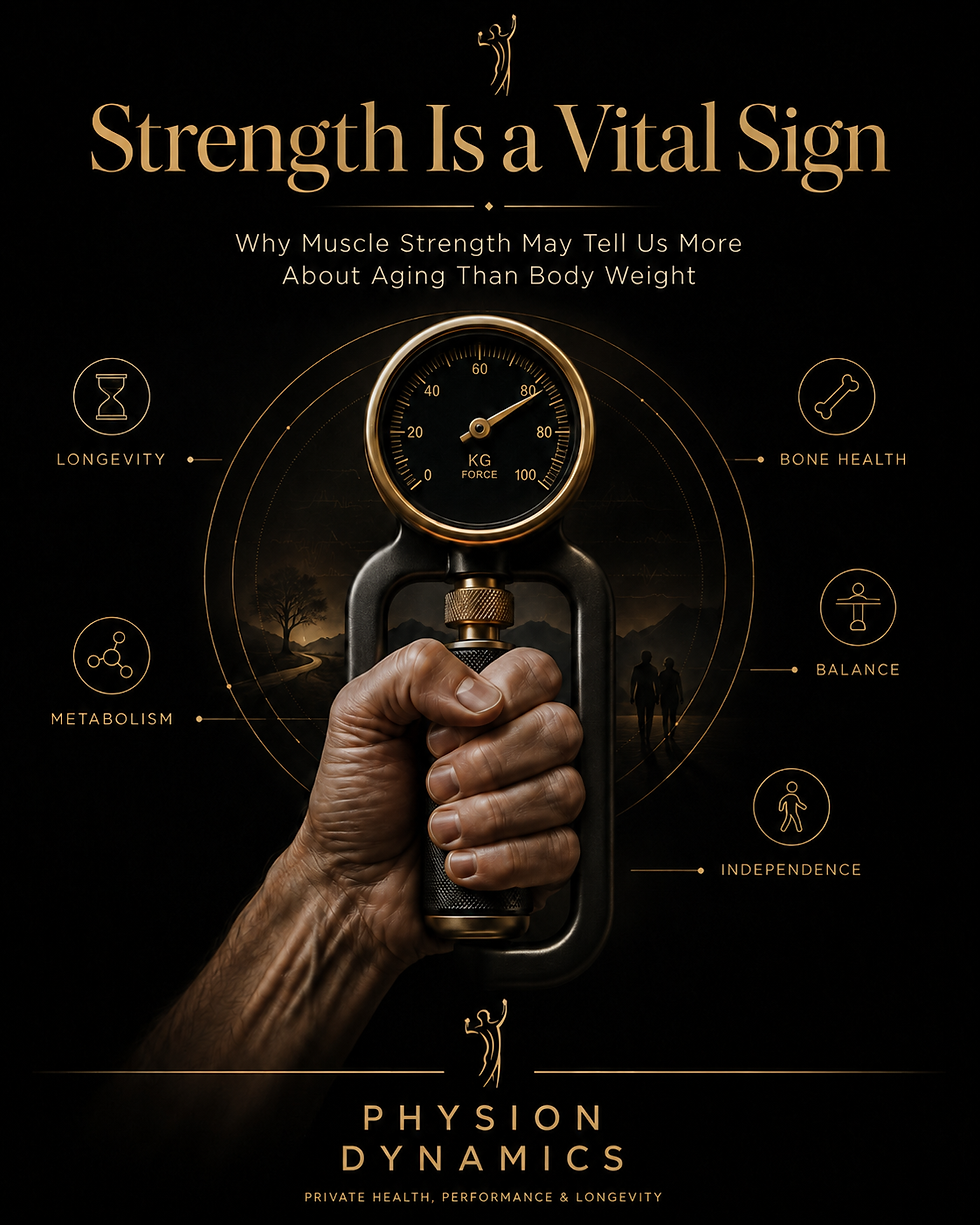
In our previous Physion Dynamics article, we called strength a vital sign. That idea belongs directly inside this conversation. Professional success can hide muscular decline because modern careers rarely demand enough physical strength to reveal the problem.
Someone can type, present, negotiate, drive, and run a company while losing meaningful physical capacity, until something finally asks for it. A heavy suitcase, a fall, an injury, a surgery, a difficult staircase, a period of bed rest, aging. That is why strength should be developed before it becomes urgently necessary.
Muscle is not merely decorative tissue. It contributes to movement, glucose disposal, physical reserve, joint function, and independence. The executive who trains for strength is not simply preparing for the gym, they are increasing the margin between what life demands and what their body is capable of handling. That margin is resilience.
Quick Answer: Should Executives Prioritize Strength or Cardio?
For most people, this is the wrong competition. Resistance training and aerobic conditioning support different but complementary aspects of health. A complete program generally includes both, alongside mobility, daily movement, and appropriate recovery.
11. The Most Dangerous Metric: “I Can Still Handle It”
High performers often have exceptional tolerance.
That may be part of what helped them become successful. Unfortunately, tolerance can disguise deterioration.
Someone can tolerate six hours of sleep, they can tolerate chronic back discomfort, they can tolerate poor digestion, they can tolerate breathlessness, they can tolerate another ten pounds, they can tolerate constant fatigue, they can tolerate relying on caffeine every afternoon. But tolerance is not optimization.
That distinction sits at the heart of the Physion Dynamics philosophy. The goal should not be to discover how much dysfunction someone can still perform through. The better goal is to increase how much physiological capacity they possess, that changes the entire relationship with health.
Instead of waiting until the body produces a diagnosis, injury, severe fatigue, or alarming test result, we begin earlier. We measure, we train, we recover, we adjust, and we refer appropriately when something requires medical investigation. We treat the body with the same strategic thinking successful people already apply to every other valuable asset in their lives.
12. From Reactive Healthcare to Proactive Health Management
There is an important boundary here. Health optimization coaching does not replace medicine. A qualified coach should not diagnose hypertension, diabetes, cardiovascular disease, sleep apnea, hormonal disorders, or any other medical condition outside their scope. Wearable devices should not be treated as laboratories. And training should never be used to explain away symptoms that require clinical investigation.
But healthcare and coaching can complement one another extremely well. Medicine can diagnose, investigate, and treat disease. Coaching can help the individual create the daily behaviors that support strength, movement, nutrition, recovery, sleep routines, and sustainable lifestyle change; that distinction matters.
If blood pressure is repeatedly elevated, the answer is not an internet supplement, it is appropriate medical assessment. If someone develops unexplained chest pain, fainting, significant shortness of breath, neurological symptoms, or a sudden decline in exercise tolerance, the solution is not to “push through", it is clinical evaluation.
But when someone is medically stable and simply watching their physical fitness disappear beneath an increasingly demanding lifestyle, good coaching can become extraordinarily valuable, true health optimization means knowing which problem belongs where.
Some problems require behavior change, some require coaching, some require medicine, and sometimes the most intelligent solution involves all three working together.
13. The Physion Dynamics High-Performance Health Dashboard
If professional output cannot tell us whether someone is healthy, what should?
There is no single perfect metric.
Health should be viewed more like an aircraft cockpit than a bathroom scale. A pilot would never examine one instrument and declare the entire aircraft healthy. The human body deserves the same sophistication. Blood pressure tells us something about cardiovascular load. Appropriate laboratory testing can provide information about glucose regulation, blood lipids, blood counts, organ function, and other medically relevant variables. Body composition and waist circumference provide more context than body weight alone. Strength tells us something about physical capacity. Cardiorespiratory fitness tells us something different. Sleep adds another layer. So do movement, recovery, resting heart rate, exercise tolerance, energy, digestion, and pain.
None of these measurements should become an obsession. Together, however, they create visibility. And that is exactly what the high-performing professional needs, not more anxiety, not another gadget.
Better visibility. Because the earlier a meaningful change is recognized, the more opportunity there may be to respond intelligently.
Quick Answer: What Should a Busy Professional Monitor?
There is no universal dashboard for every person. At minimum, busy professionals should know basic clinical information such as blood pressure and complete appropriate medical screening while also paying attention to strength, aerobic fitness, sleep, movement, body composition, recovery, and physical performance.
14. The Physion Dynamics Approach: Optimize Before You Are Forced to Repair
Traditional fitness usually begins with appearance.
Lose weight, build muscle, look better. There is nothing wrong with those goals, but Physion Dynamics has to go further.
The busy professional does not simply need a smaller waist or larger shoulders. They need a body capable of supporting the next twenty, thirty, and forty years of the life they are working so hard to build.
That means protecting strength as careers become more sedentary, maintaining aerobic capacity while schedules become busier, protecting sleep while responsibilities expand, building nutrition systems that survive travel, managing recovery before fatigue becomes chronic, and preserving physical reserve before age begins narrowing the boundaries of daily life.
This is why I do not view my role simply as giving someone workouts. The workout is one tool. The objective is to create an environment in which the person’s physiology can continue supporting their ambition.
Sometimes that means pushing harder, sometimes it means recovering, sometimes it means changing nutrition, sometimes it means rebuilding mobility, and sometimes it means saying:
“That needs to be discussed with your physician.”
That is what Lifestyle Transformation and Health Optimization Coaching should look like.
Not more noise. Better decisions.
15. Success Should Not Be Purchased With Your Future Health
There is a strange irony at the centre of high performance. People spend decades building a life they eventually hope to enjoy. The company, the career, the house, the financial security, the travel, the freedom, the family, and while they are building all of it, the body responsible for allowing them to experience that life can quietly become the least protected asset in the portfolio.
That is backwards.
Health matters not only because disease is unpleasant. Health creates options, strength creates options, fitness creates options, mobility creates options, energy creates options.
A resilient body allows someone to work, travel, explore, play, parent, compete, build, and remain independent. The ultimate luxury is not merely having the resources to do what you want. It is having a body capable of joining you.
Conclusion: High Functioning Is Not the Finish Line
The ability to perform under pressure is admirable, but it is not proof that everything underneath is healthy.
The body can compensate for a surprisingly long time and that is precisely why proactive health management matters.
Do not wait for pain to become the messenger. Do not wait until exhaustion becomes part of your identity. Do not assume that professional success protects you from cardiovascular, metabolic, or musculoskeletal risk. And do not judge an extraordinarily complex biological system using nothing more than body weight and whether you survived another workday.
Look deeper, know your numbers, build strength, protect cardiorespiratory fitness, move throughout the day, treat sleep as biological infrastructure, eat in a way that supports the life you are asking your body to sustain, recover deliberately, use data intelligently and involve qualified healthcare professionals whenever clinical assessment is appropriate.
Most importantly, build the system before the system breaks.
Because being able to perform does not necessarily mean your body is performing well.
At Physion Dynamics, the goal is not simply to help someone function, it is to build enough physical capacity, health awareness, structure, and resilience that they can continue performing without quietly using their future health to finance the present.
That is the difference between surviving success and being physically prepared to enjoy it.
Physion Dynamics Takeaway
The greatest danger for a high-performing professional may not be obvious illness. It may be the ability to compensate so effectively that declining health remains invisible.
Professional performance tells us what you can produce.
It does not tell us your blood pressure. It does not tell us your visceral fat. It does not tell us your aerobic capacity. It does not tell us how much strength you have lost. It does not tell us how restorative your sleep is. And it does not tell us how much physiological reserve remains.
Success should increase your ability to invest in your health, not become the reason you neglect it.
Call to Action
If you are an executive, entrepreneur, professional, or high performer who appears successful on the outside but knows your health has gradually moved further down the priority list, the answer is not another generic twelve-week challenge. The next step is understanding what your body actually needs.
The Physion Dynamics Concierge Private Health & Performance Review examines the lifestyle surrounding your physiology: training, nutrition, strength, mobility, cardiovascular conditioning, sleep, stress, travel, recovery, schedule demands, body-composition goals, and the barriers preventing consistency.
Where medical assessment is appropriate, that belongs with the appropriate regulated healthcare professional. Where lifestyle and performance can be improved, we build the system around your real life. Not an imaginary perfect week.
Physion DynamicsPrivate Health, Performance & Longevity Coaching
For executives, professionals, athletes, and high performers who understand that their body is not separate from their ambition.
It is the infrastructure beneath it.
FAQ
1. What is the High-Functioning Health Crisis?
It is not a medical diagnosis. It describes a pattern where someone remains professionally productive while areas such as sleep, blood pressure, fitness, strength, body composition, or recovery gradually deteriorate.
2. Can I have high blood pressure without knowing it?
Yes. Hypertension often causes no obvious symptoms, which is why objective blood pressure measurement is important.
3. Can someone look healthy but have poor cardiovascular health?
Yes. Appearance cannot directly reveal blood pressure, blood lipids, glucose regulation, aerobic fitness, or several other cardiovascular risk factors.
4. How much sleep should adults get?
Adults are generally advised to obtain at least seven hours of sleep per night on a regular basis, although individual sleep requirements vary.
5. Does poor sleep affect metabolism?
Research suggests that sleep restriction can affect insulin sensitivity, hunger, food intake, recovery, and cognitive performance. One short night is not a metabolic catastrophe, but repeated inadequate sleep matters.
6. Is sitting still a problem if I exercise?
Exercise is highly beneficial, but long periods of sedentary behavior are still worth reducing. A healthy lifestyle includes both structured exercise and regular movement throughout the day.
7. Is visceral fat different from ordinary body fat?
Yes. Visceral fat is stored around internal organs inside the abdominal cavity and is associated with cardiometabolic risk when present in excess.
8. Should executives track VO₂ max?
Not everyone needs formal laboratory testing, but cardiorespiratory fitness is an important marker of physical health. It can be assessed in several ways depending on the individual.
9. Is stress always unhealthy?
No. Stress is a normal biological response. Problems become more likely when stress is excessive, prolonged, poorly recovered from, or accompanied by poor sleep, inactivity, and unhealthy coping behaviors.
10. Can a Health Optimization Coach replace my physician?
No. Health optimization coaching should complement medical care, not replace it. Medical diagnosis, treatment, medication management, and investigation of abnormal findings belong with qualified regulated healthcare professionals.
Written By - Dragos Mutascu
Owner & Head Coach, Physion DynamicsLifestyle Transformation & Health Optimization Coach
Dragos Mutascu is the founder of Physion Dynamics, a private health, performance, and longevity coaching service designed for busy professionals, executives, athletes, and aging adults.
With an academic background in kinesiology and health sciences, graduate education, professional fitness and nutrition certifications, and ongoing physiotherapy education, Dragos approaches coaching from a broader perspective than exercise alone.
His work integrates strength, movement, nutrition, recovery, lifestyle structure, and long-term physical performance to help clients build health systems capable of surviving demanding real-world schedules.
At Physion Dynamics, the philosophy is simple:
Build the body to support the life.

Comments